The Blueprint | Section 01

WE KNOW WHAT FAILED. NOW IT'S TIME TO BUILD WHAT WILL ENDURE.

The evidence has revealed the risks. The architecture has exposed the dependencies. The engineering principles are understood.

Now we move beyond observation. Beyond analysis. Beyond another warning.

Now we begin the work of engineering a more resilient future.

The Crescendo of Purpose

THE TIME FOR OBSERVING FAILURE FROM BEHIND A DESK IS OVER.

We have watched infrastructure age. We have watched dependencies multiply. We have watched essential services become vulnerable to failures far beyond the control of the people who depend upon them.

And along the way, we have developed extraordinary engineering capabilities. We know how to isolate failures. We know how to create redundancy. We know how to design for continuity. We know how to verify recovery.

The question is no longer whether the knowledge exists. The question is what we will do with everything we have learned.

WILL WE CONTINUE DOCUMENTING FAILURES, OR APPLY OUR KNOWLEDGE TO PREVENT THEM?

WILL WE ACCEPT INHERITED LIMITATIONS, OR CHALLENGE THE ASSUMPTIONS THAT CREATED THEM?

WILL WE DESIGN FOR EFFICIENCY ALONE, OR ENGINEER FOR THE PRESERVATION OF LIFE?

The Blueprint is not owned by one architect, corporation, government, or industry.

It requires engineers, cybersecurity professionals, infrastructure operators, builders, community leaders, businesses, and residents working across disciplines.

Each has a responsibility. Each has knowledge to contribute. And each has a role in making resilience measurable.

From Knowledge to Action

THE BLUEPRINT BEGINS WHEN KNOWLEDGE BECOMES RESPONSIBILITY — AND RESPONSIBILITY BECOMES ACTION.

Not through fear. Not through blame. And not through promises that cannot be verified.

Through sound architecture, measurable accountability, independent resilience, and the collective determination to protect what matters.

Think Differently. Engineer Securely. Protect What Matters.
The Blueprint | Section 02

SIX DISCIPLINES. ONE SHARED RESPONSIBILITY. A NATION BUILT TO ENDURE.

The work begins by confronting the dependencies we have inherited, then engineering the capabilities necessary to withstand disruption.

These six pillars establish a shared framework for architects, engineers, infrastructure operators, policymakers, businesses, and communities to turn resilience into measurable results.

PILLAR 01

EXPOSE THE DEPENDENCIES

Every essential service depends on resources, technologies, suppliers, and decisions that may not be visible to the people relying upon them.

Map the complete dependency chain, including upstream providers, shared infrastructure, hidden single points of failure, and recovery dependencies.

Engineering Outcome

A verified dependency map identifying critical services, shared risks, and failure paths.

PILLAR 02

RESTORE INDEPENDENT CAPABILITY

Independence does not mean abandoning shared systems. It means preserving the ability to sustain essential functions when shared systems fail.

Engineer safe alternative pathways for energy, water, communications, technology, and critical supplies.

Engineering Outcome

Demonstrated continuity of defined essential functions without primary infrastructure.

PILLAR 03

ENGINEER FAILURE BOUNDARIES

A localized failure should not automatically become a regional or national crisis.

Design isolation, segmentation, independent recovery paths, and controlled interconnections that prevent cascading failures across essential services.

Engineering Outcome

Tested failure boundaries demonstrating that disruption remains contained.

PILLAR 04

REBUILD CRITICAL INFRASTRUCTURE

Aging infrastructure and preventable resource losses create vulnerabilities long before a visible failure.

Prioritize modernization, measurable loss reduction, distributed capabilities, maintainability, and recovery-focused design.

Engineering Outcome

An evidence-based modernization plan with measurable reliability, resource-efficiency, and recovery targets.

PILLAR 05

ESTABLISH ACCOUNTABILITY

Resilience cannot depend on assumptions about who is responsible when systems fail.

Assign clear ownership for infrastructure risks, continuity, maintenance, recovery, and independent verification.

Engineering Outcome

Named accountable owners, published performance measures, and independently verified continuity results.

PILLAR 06

MOBILIZE THE ARCHITECTS

No single profession can engineer national resilience in isolation.

Bring together experienced architects and practitioners across cybersecurity, utilities, healthcare, agriculture, transportation, construction, communications, and public safety.

Engineering Outcome

A cross-disciplinary blueprint with defined responsibilities, implementation milestones, and independently testable results.

The Responsibility We Share

THE FUTURE CANNOT BE ENGINEERED IN SILOS.

A cybersecurity architect understands trust boundaries. A power engineer understands energy continuity. A water engineer understands supply, treatment, and recovery.

Healthcare professionals understand what happens when critical services become unavailable. Transportation specialists understand supply dependencies. Builders understand the physical systems that sustain our communities.

These disciplines must work together because the systems they protect are interconnected.

THE BLUEPRINT IS NOT ABOUT WHO GETS THE CREDIT. IT IS ABOUT WHAT WE CAN ACCOMPLISH TOGETHER.

From Principles to Proof

A BLUEPRINT IS NOT COMPLETE UNTIL IT CAN BE BUILT, TESTED, AND VERIFIED.

The next step is to turn these principles into implementation requirements, measurable outcomes, and independently tested recovery capabilities.

The Blueprint Is Only The Beginning. Implementation Is The Proof
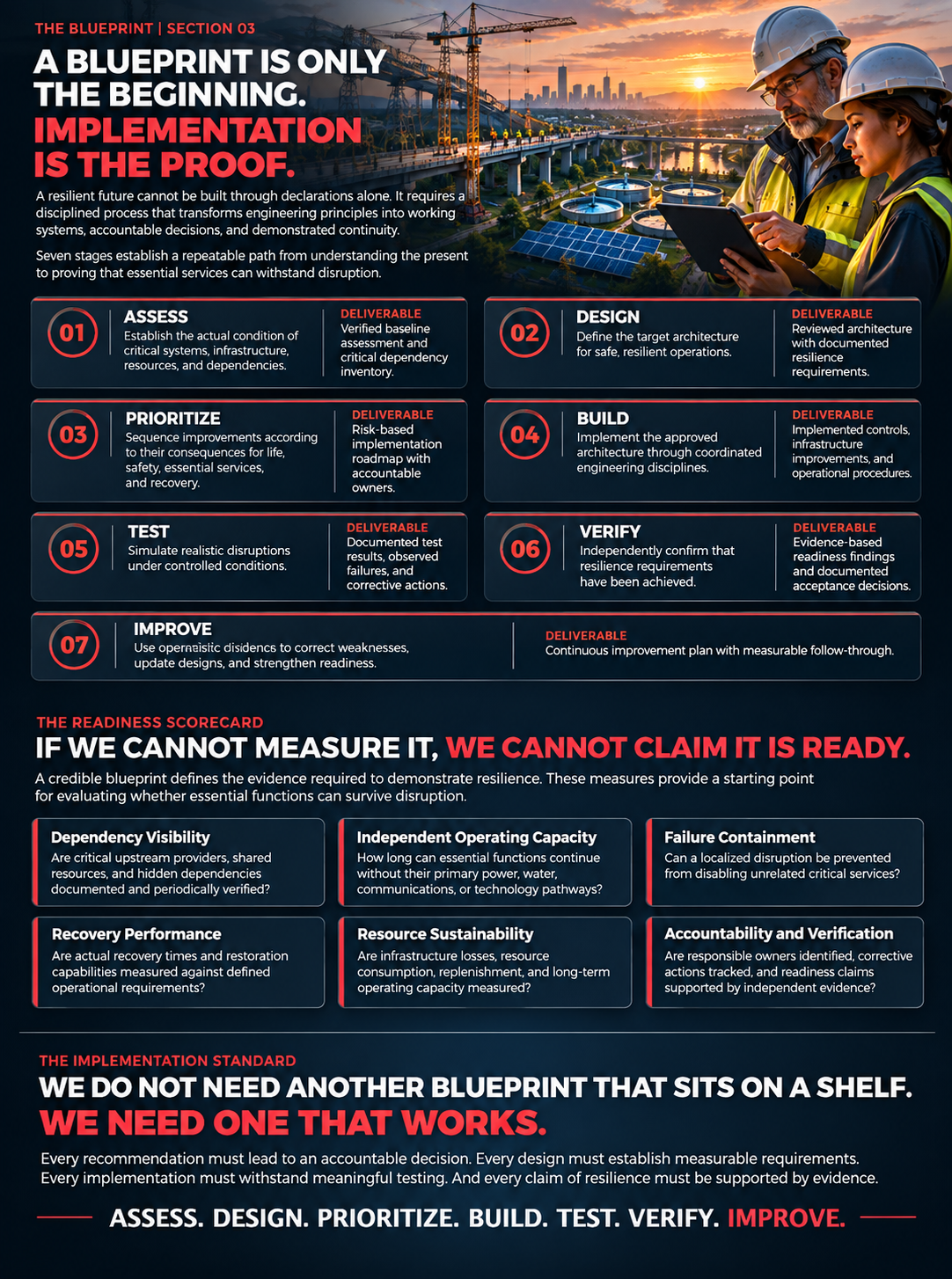
The Blueprint | Section 03

A BLUEPRINT IS ONLY THE BEGINNING. IMPLEMENTATION IS THE PROOF.

A resilient future cannot be built through declarations alone. It requires a disciplined process that transforms engineering principles into working systems, accountable decisions, and demonstrated continuity.

Seven stages establish a repeatable path from understanding the present to proving that essential services can withstand disruption.

From Architecture to Action

SEVEN STAGES. ONE STANDARD OF PROOF.

Every stage must produce evidence that can be reviewed, tested, and used to guide the next decision.

01

ASSESS

Establish the actual condition of critical systems, infrastructure, resources, and dependencies.

Identify aging assets, capacity constraints, single points of failure, security weaknesses, and operational assumptions.

Deliverable: Verified baseline assessment and critical dependency inventory.
02

DESIGN

Define the target architecture for safe, resilient operations.

Establish isolation boundaries, alternative supply pathways, independent recovery capabilities, security controls, and continuity requirements.

Deliverable: Reviewed architecture with documented resilience requirements.
03

PRIORITIZE

Sequence improvements according to their consequences for life, safety, essential services, and recovery.

Evaluate urgency, feasibility, cost, dependencies, and the consequences of delay.

Deliverable: Risk-based implementation roadmap with accountable owners.
04

BUILD

Implement the approved architecture through coordinated engineering disciplines.

Modernize critical assets, establish alternative capabilities, enforce security boundaries, and document operational responsibilities.

Deliverable: Implemented controls, infrastructure improvements, and operational procedures.
05

TEST

Simulate realistic disruptions under controlled conditions.

Examine loss of power, communications, suppliers, technology, water, and other essential dependencies. Test both isolated and cascading failure scenarios.

Deliverable: Documented test results, observed failures, and corrective actions.
06

VERIFY

Independently confirm that resilience requirements have been achieved.

Measure actual recovery times, service continuity, resource availability, and the effectiveness of isolation and backup capabilities.

Deliverable: Evidence-based readiness findings and documented acceptance decisions.
07

IMPROVE

Use operational evidence to correct weaknesses, update designs, and strengthen readiness.

Reassess as infrastructure, technology, threats, communities, and dependencies change.

Deliverable: Continuous improvement plan with measurable follow-through.

The Readiness Scorecard

IF WE CANNOT MEASURE IT, WE CANNOT CLAIM IT IS READY.

A credible blueprint defines the evidence required to demonstrate resilience. These measures provide a starting point for evaluating whether essential functions can survive disruption.

Dependency Visibility

Are critical upstream providers, shared resources, and hidden dependencies documented and periodically verified?

Independent Operating Capacity

How long can essential functions continue without their primary power, water, communications, or technology pathways?

Failure Containment

Can a localized disruption be prevented from disabling unrelated critical services?

Recovery Performance

Are actual recovery times and restoration capabilities measured against defined operational requirements?

Resource Sustainability

Are infrastructure losses, resource consumption, replenishment, and long-term operating capacity measured?

Accountability and Verification

Are responsible owners identified, corrective actions tracked, and readiness claims supported by independent evidence?

The Implementation Standard

WE DO NOT NEED ANOTHER BLUEPRINT THAT SITS ON A SHELF. WE NEED ONE THAT WORKS.

Every recommendation must lead to an accountable decision. Every design must establish measurable requirements. Every implementation must withstand meaningful testing.

And every claim of resilience must be supported by evidence.

Assess. Design. Prioritize. Build. Test. Verify. Improve.
The Blueprint | Section 04

THE NATIONAL RESILIENCE ARCHITECTURE.

America is not one system. It is a network of interdependent systems that sustain the lives, livelihoods, and security of its people.

The challenge is not to eliminate every connection. It is to engineer connections that create value without allowing one failure to become a national catastrophe.

A NATION IS NOT RESILIENT BECAUSE EVERYTHING IS CONNECTED. IT IS RESILIENT WHEN ESSENTIAL SYSTEMS CAN CONTINUE TO FUNCTION EVEN WHEN THOSE CONNECTIONS FAIL.
The Systems That Sustain Life

EIGHT ESSENTIAL SYSTEMS. ONE SHARED RESPONSIBILITY.

Each system must be engineered for secure interoperation, defined failure boundaries, and appropriate continuity when supporting infrastructure is disrupted.

01

WATER AND SANITATION

Protect safe water production, treatment, distribution, wastewater management, and emergency supply. Plan for power loss, contamination events, and distribution failures.

02

ENERGY AND POWER

Strengthen generation, transmission, distribution, and local backup capacity. Evaluate microgrids, energy storage, fuel availability, and safe islanded operation where technically feasible.

03

FOOD AND AGRICULTURE

Protect agricultural production, processing, refrigeration, transportation, and distribution. Reduce avoidable dependence on single supply routes and fragile logistics chains.

04

COMMUNICATIONS

Establish resilient voice, data, emergency notification, and coordination pathways. Identify dependencies on centralized networks, power, and external providers.

05

HEALTHCARE

Sustain emergency treatment, critical medical equipment, pharmaceuticals, patient information, and care coordination during infrastructure and technology disruptions.

06

TRANSPORTATION AND LOGISTICS

Protect essential movement of people, food, medicine, fuel, and emergency resources. Design alternate routes, manual operating procedures, and restoration priorities.

07

PUBLIC SAFETY

Support emergency response, dispatch, incident command, evacuation, and community protection with reliable communications, power, and continuity procedures.

08

DIGITAL INFRASTRUCTURE

Secure the identity systems, networks, cloud services, industrial controls, data, and software dependencies supporting every other sector. Prevent cyber failures from cascading into physical consequences.

Engineering the Whole System

FOUR ARCHITECTURAL LAYERS. RESILIENCE BY DESIGN.

A resilient national architecture must operate across local, regional, and national boundaries without surrendering every critical function to the same dependency.

Layer 01

LOCAL OPERATING CAPABILITY

Establish practical continuity at the facility, household, neighborhood, and community levels. Define which essential functions must remain available when external infrastructure is lost.

Layer 02

REGIONAL COORDINATION AND MUTUAL SUPPORT

Enable neighboring communities, utilities, healthcare providers, and emergency organizations to share resources and coordinate recovery without introducing unnecessary common points of failure.

Layer 03

SECURE NATIONAL INTEROPERABILITY

Establish standards for secure information exchange, compatible emergency procedures, trusted coordination, and accountable cooperation across industries and jurisdictions.

Layer 04

INDEPENDENT VERIFICATION AND IMPROVEMENT

Validate that local, regional, and national arrangements can meet their continuity requirements. Use independent testing, performance evidence, and corrective action to strengthen the architecture.

Resilience Begins Where People Live

NATIONAL RESILIENCE MUST REACH THE COMMUNITY.

A national strategy cannot be considered complete if families, hospitals, small businesses, and local communities remain unable to sustain essential functions during a major disruption.

Communities need practical options for safe water, emergency power, communications, local resource management, and coordinated recovery.

These capabilities must be engineered responsibly, maintained properly, and aligned with applicable health, safety, and environmental requirements.

Questions Every Community Should Ask

How will residents obtain safe water if normal distribution is interrupted?

Which facilities can maintain emergency power, and for how long?

How will residents receive reliable information if primary communications fail?

Where are emergency supplies, medical resources, and alternate operating sites?

Who coordinates decisions, and how will recovery be tested before it is needed?

From Architecture to Evidence

THE ARCHITECTURE MUST PROVE ITS READINESS.

A resilience architecture is not complete merely because its components are connected. It must demonstrate how essential services behave when those connections fail.

Continuity Duration

Measure how long critical functions can operate without their primary supporting infrastructure.

Recovery Time

Measure actual restoration performance against defined service requirements.

Dependency Independence

Verify that alternate capabilities do not rely on the same failed upstream resource.

Failure Containment

Test whether disruptions remain within designed boundaries instead of spreading across sectors.

Resource Availability

Verify adequate water, fuel, energy, equipment, staffing, and supplies for defined operating periods.

Independent Verification

Document test evidence, accountable owners, unresolved deficiencies, and corrective actions.

One Nation. Shared Responsibility.

WE CANNOT PROTECT A NATION BY ENGINEERING EACH SYSTEM AS THOUGH THE OTHERS DO NOT EXIST.

The future requires engineers, infrastructure operators, security architects, community leaders, and decision-makers to understand the dependencies they share and the responsibilities they cannot delegate.

We must connect intelligently, isolate failures deliberately, preserve essential capabilities, and prove that our systems can endure.

Think Differently. Engineer Securely. Protect What Matters.
The Blueprint | Section 05

THE CALL TO REBUILD AMERICA.

America has extraordinary engineering knowledge, technical experience, industrial capability, and people who understand how essential systems work.

Across our nation are architects, engineers, scientists, builders, operators, security professionals, and experienced leaders who have spent their lives solving difficult problems.

The challenge is to bring that knowledge together across disciplines, institutions, industries, and communities.

WE ARE NOT WAITING FOR SOMEONE ELSE TO REBUILD AMERICA. WE ARE THE ARCHITECTS, ENGINEERS, AND BUILDERS WHO MUST COME TOGETHER TO MAKE IT HAPPEN.
A diverse group of American engineers, healthcare professionals, infrastructure specialists, military personnel and leaders standing together for national resilience.
Different disciplines. Shared responsibility. One nation worth protecting.
The Knowledge Already Exists

THE FUTURE WILL BE BUILT BY PEOPLE WHO KNOW HOW THINGS ACTUALLY WORK.

No single profession, organization, or industry holds every answer. National resilience requires the combined expertise of those who design, operate, maintain, secure, and restore essential systems.

ENGINEERS AND ARCHITECTS

Civil, structural, electrical, mechanical, systems, and cybersecurity professionals who understand how to design reliable infrastructure, establish failure boundaries, and build for continuity.

INFRASTRUCTURE OPERATORS

Utility professionals, plant operators, transportation specialists, communications engineers, and maintenance teams who understand the realities of operating critical systems.

SCIENTISTS AND INNOVATORS

Researchers, inventors, technology developers, and resource specialists who can improve efficiency, strengthen materials, reduce losses, and create practical alternatives.

HEALTHCARE AND EMERGENCY LEADERS

Medical professionals, emergency managers, public safety specialists, and disaster recovery teams who understand the human consequences of infrastructure failure.

BUILDERS AND SKILLED TRADES

Construction professionals, electricians, technicians, equipment specialists, and skilled tradespeople who turn engineering designs into safe, functioning physical infrastructure.

COMMUNITIES AND DECISION-MAKERS

Local leaders, business owners, educators, public officials, and residents who establish priorities, steward resources, and hold institutions accountable for results.

One Nation. Shared Responsibility.

WE WILL NOT REBUILD OUR NATIONAL STRENGTH WORKING IN SILOS.

Energy engineers must understand the needs of water utilities. Healthcare leaders must understand their communications and power dependencies. Cybersecurity architects must understand the physical consequences of digital failure.

Communities must have a voice in the systems that sustain their lives.

Every discipline must be willing to work with the others to design solutions that are stronger together.

The Standard for Collaboration

Share knowledge across professional boundaries.

Examine the entire system, not merely individual components.

Challenge assumptions with evidence.

Put public safety and essential services first.

Assign responsibility and measure results.

Build solutions that others can operate, test, maintain, and improve.

From Shared Vision to Shared Work

THE WORK BEGINS WITH WHAT WE CAN PROVE.

Rebuilding national resilience is not a single project. It is a disciplined, long-term commitment to improving the systems that protect our people and sustain our economy.

01

MAKE DEPENDENCIES VISIBLE

Identify hidden connections, shared providers, and critical weaknesses that can turn local failures into widespread disruptions.

02

DEFINE ESSENTIAL CAPABILITIES

Establish what must continue functioning to protect human life, public safety, and community stability.

03

BUILD AND VALIDATE SOLUTIONS

Develop practical designs, test them under realistic conditions, and document whether they meet their requirements.

04

SHARE WHAT WORKS

Make validated principles, repeatable methods, and lessons learned available for adaptation across industries and communities.

The Responsibility We Share

LET US BUILD AN AMERICA WHOSE STRENGTH CAN ENDURE.

An America where essential services are designed to withstand disruption.

Where communities have the knowledge and capabilities to protect their people.

Where innovation is measured by what it improves, engineering by what it proves, and leadership by the responsibility it accepts.

Where our greatest minds do not work in isolation, but bring their experience together for a purpose greater than themselves.

AMERICA'S GREATEST STRENGTH IS NOT FOUND IN ANY SINGLE SYSTEM. IT IS FOUND IN THE PEOPLE WILLING TO COME TOGETHER TO BUILD WHAT WILL ENDURE.
Think Differently. Engineer Securely. Protect What Matters.