Cyber Secure Online | A Global Wake-Up Call

The Illusion of Control.

We Secured Our Doors. We Surrendered the Keys.

We built a global economy on interconnected systems, third-party dependencies, and technologies we do not control, cannot fully verify, and cannot independently protect.

See the Evidence →

The Greatest Threat May Not Be Inside Your Organization.

You can secure every system you own. Harden every server. Protect every endpoint. Monitor every connection.

But what happens when the systems keeping your organization alive are outside your control?

The vulnerability wasn't in your building. It was in the world your building depends upon.

The Evidence / Chapter 01

THE FRONT DOOR YOU NEVER KNEW EXISTED.

You can secure your own network. Protect your employees. Harden your servers. Monitor every connection. But what happens when the organization keeping your business alive is compromised?

Hospital corridor illustrating healthcare
    infrastructure and third-party cybersecurity
    dependencies
Your organization wasn't breached. Your ability to operate was.

In today's interconnected economy, your operational security depends on organizations you may not have selected, systems you cannot inspect, and infrastructure you do not control.

Healthcare / 2024

The Hospital That Didn't Have to Be Hacked

The Change Healthcare ransomware attack disrupted claims processing, payments, and other healthcare operations across the United States.

The hospitals affected did not all have to be directly breached.

The failure of a critical intermediary was enough to disrupt their operations.

American Hospital Association — Research and Reporting

Global Systems / 2024

One Update. Millions of Devices.

A defective CrowdStrike software update caused widespread Windows system failures in July 2024.

The software intended to help protect systems became a source of disruption.

Airlines, healthcare organizations, and other businesses experienced serious operational consequences.

Microsoft — Technical Reporting

Critical Dependencies

Your Backup May Share the Same Weakness

Multiple applications, providers, or security layers may still rely on the same cloud infrastructure, identity services, networks, or upstream dependencies.

Redundancy does not guarantee independence.

A shared failure can interrupt supposedly separate systems at the same time.

CISA — Infrastructure Resilience

THE VULNERABILITY WASN'T IN YOUR BUILDING. IT WAS IN THE WORLD YOUR BUILDING DEPENDS UPON.

A vulnerability does not have to be deliberately exploited to reveal a dangerous architectural weakness.

Sometimes a cyberattack exposes it. Sometimes a defective update exposes it. Sometimes an outage exposes it.

The underlying dependency existed before the incident. The incident simply made it impossible to ignore.

Next: The Illusion of Independence →

The Evidence / Chapter 02

THE ILLUSION OF INDEPENDENCE.

You locked your doors. You secured your systems. You invested in protection. But who controls the infrastructure keeping everything alive?

Global communications, electrical
        infrastructure, cloud networks and
        interconnected digital dependencies

Travel & Transportation

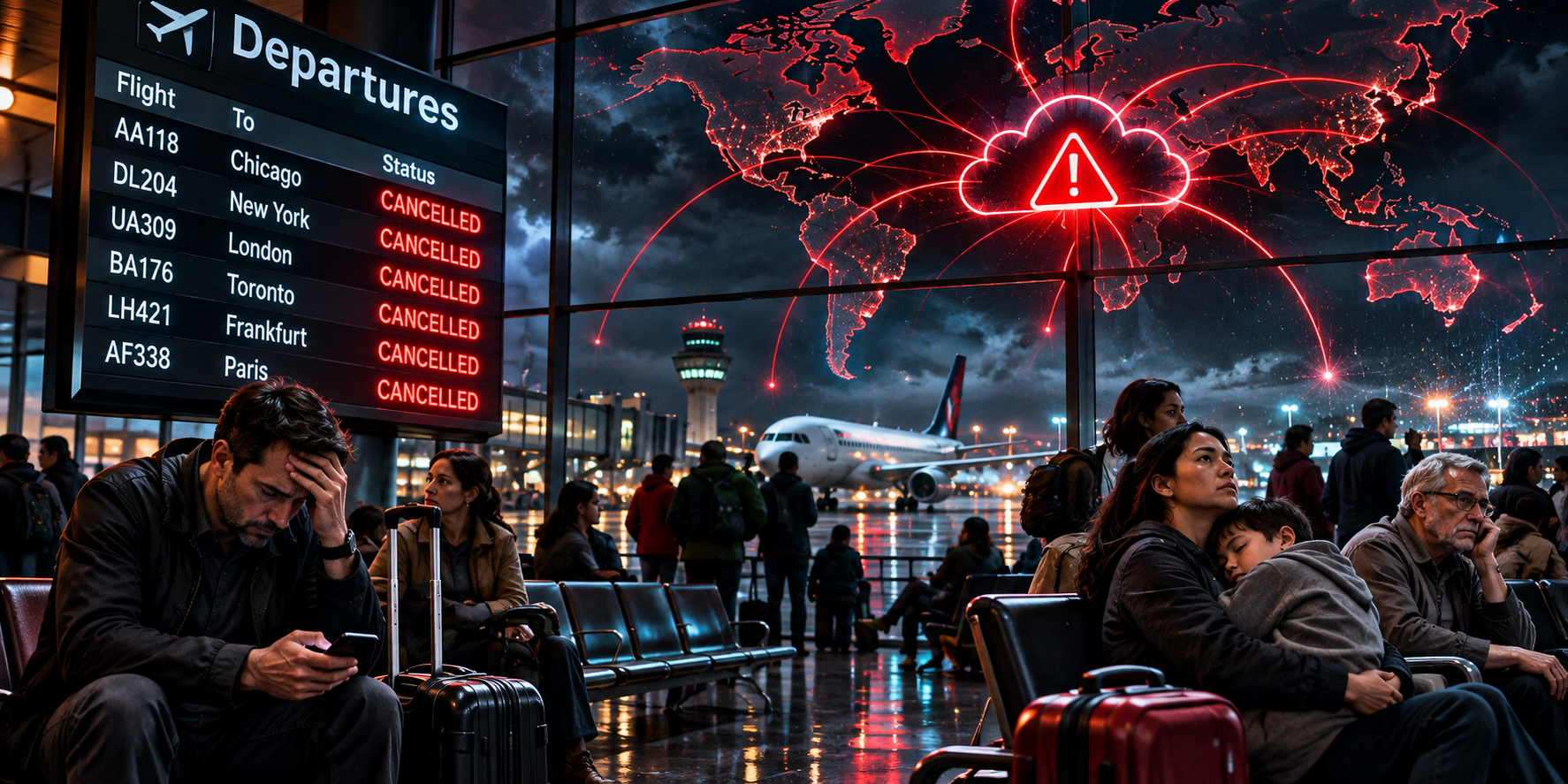
A defective update to a trusted security product disrupted airline and airport operations around the world in July 2024.

The disruption was not an attack against every affected airline. A shared dependency failed.

Financial Services

Outages and third-party incidents can interrupt payment processing, banking applications, and essential financial operations.

Different institutions can experience disruption from the same underlying dependency.

Cloud & Shared Infrastructure

Major cloud, identity, and network providers have experienced outages affecting organizations that otherwise operate independently.

Different companies. Different industries. The same underlying exposure.

YOU PROTECTED YOUR HOUSE. BUT WHO PROTECTED EVERYTHING YOUR HOUSE DEPENDS UPON?

Imagine protecting your home with the most sophisticated security systems available.

Your doors are locked. Your windows are secured. Your cameras are operating. Your alarms are armed.

Then the electrical grid fails. Your communications provider goes down. Your water supply is interrupted.

You did not leave a door open. You did not invite an intruder inside. But your ability to operate has been compromised by something outside your control.

Now imagine that same dependency across hospitals, financial systems, transportation networks, businesses, and government operations.

Dependency 01

Electrical Infrastructure

Digital systems require reliable electricity. Backup power can reduce exposure, but continuity depends on capacity, maintenance, fuel, and recovery planning.

Dependency 02

Communications Networks

Internet connectivity, telecommunications, DNS, and routing services connect organizations to the systems they depend upon. Their failure can interrupt otherwise healthy applications.

Dependency 03

Cloud & Identity Providers

Applications, authentication, storage, and recovery systems may share infrastructure. A common failure can affect multiple supposedly separate services simultaneously.

Dependency 04

Third-Party Supply Chains

Software vendors, payment processors, healthcare intermediaries, and external service providers can introduce operational exposure beyond an organization's direct control.

REDUNDANCY DOES NOT GUARANTEE INDEPENDENCE.

Two applications may depend on the same cloud. Two security products may rely on the same identity service. Two backup systems may share the same electrical or communications infrastructure.

If those supposedly independent layers share a critical point of failure, the failure can reach them all.

The question is no longer simply whether your organization has cybersecurity protection.

The question is whether you understand the complete chain of dependencies upon which that protection relies.

Next: The AI Acceleration →

The Evidence / Chapter 03

AI DIDN'T CREATE THE GAPS. IT CHANGED THE SPEED OF EXPLOITATION.

We spent decades accumulating architectural weaknesses, insecure code, excessive privileges, and unverified dependencies. Now artificial intelligence is accelerating the search for them.

Artificial intelligence analyzing
        interconnected digital infrastructure
        and cybersecurity vulnerabilities
WE SPENT DECADES BUILDING THE VULNERABILITIES. NOW WE'VE ACCELERATED THE SEARCH FOR THEM.

Artificial intelligence has fundamentally changed the economics of cybersecurity.

Tasks that once required significant time and specialized effort can increasingly be assisted by automated analysis.

Reconnaissance can be accelerated. Source code can be examined at scale. Misconfigurations can be investigated. Potential weaknesses can be prioritized.

These capabilities are valuable to defenders. But they can also benefit sophisticated adversaries.

And the systems being examined may contain years of accumulated technical debt that no security dashboard can simply erase.

EXPOSURE 01

Insecure Software Foundations

Applications built without security-first engineering can carry weaknesses throughout their operational lives. Adding protective tools later does not necessarily correct the underlying architecture.

EXPOSURE 02

Accelerated Reconnaissance

AI-assisted techniques can accelerate the analysis of publicly exposed systems, software weaknesses, and potential attack paths. Defenders must understand what their environments expose.

EXPOSURE 03

Unverified AI-Generated Code

Faster development does not guarantee secure development. AI-generated code still requires security review, testing, dependency verification, and architectural oversight.

EXPOSURE 04

Automation Without Understanding

Security automation can improve detection and response. But it cannot substitute for knowing the system, validating trust boundaries, and identifying weaknesses in the architecture.

YOU CANNOT AUTOMATE YOUR WAY OUT OF AN ARCHITECTURE YOU DON'T UNDERSTAND.

AI is not inherently the enemy. It is a powerful capability whose consequences depend on how it is designed, deployed, governed, and used.

But faster detection is not the same as eliminating structural exposure.

If the foundation is insecure, if the dependencies are unknown, and if the trust boundaries have never been validated, automation alone cannot establish genuine security.

Security-first engineering must move faster than the vulnerabilities we're continuing to create.

Next: The Architecture of Accountability →

The Evidence / Chapter 04

WE BUILT A CONNECTED WORLD. BUT WHO VERIFIED THE TRUST?

We verify that applications function. We verify that systems connect. We verify that transactions complete. But who verifies the entire chain of trust upon which they depend?

Complex global digital infrastructure
        showing interconnected trust relationships,
        networks, and critical systems

FAILURE 01

Trust Without Verification

Software is trusted because it is widely used. Providers are trusted because they are established. Integrations are trusted because they function.

But widespread adoption is not proof of secure architecture.

FAILURE 02

Security Added After Development

Applications can reach production with unnecessary privileges, insecure dependencies, and architectural weaknesses that were never adequately challenged.

Security products cannot automatically correct insecure foundations.

FAILURE 03

Accountability Lost Between Providers

Organizations depend on vendors that depend on other vendors. Responsibility becomes fragmented across contracts, technical boundaries, and supply chains.

The consequences cross boundaries even when accountability does not.

WE VERIFIED THAT IT WORKED. BUT DID WE VERIFY THAT IT COULD BE TRUSTED?

For decades, organizations have invested in technologies that promise efficiency, convenience, scalability, and security.

But the question is not simply whether a system performs its intended function.

Who developed it? Who maintains it? Who can change it? What privileges does it hold? What other systems does it trust? And what happens if any one of those relationships fails?

Security cannot be treated as something installed after the architecture has already established the risks.

It must be engineered into the foundation and continuously verified as systems evolve.

REQUIREMENT 01

Understand the Architecture

Identify critical assets, dependencies, trust boundaries, privileged access, data flows, and shared points of failure. You cannot protect what you have never fully examined.

REQUIREMENT 02

Verify the Supply Chain

Evaluate software provenance, vendor practices, update mechanisms, subcontractors, and upstream dependencies. Trust must be supported by evidence, not reputation.

REQUIREMENT 03

Engineer for Failure

Design isolation, containment, independent recovery, and continuity of essential services. Test what happens when cloud, identity, communications, or power services become unavailable.

REQUIREMENT 04

Make Accountability Visible

Establish ownership of security decisions, document dependencies, verify controls, and continually reassess exposure as systems and providers change. Responsibility cannot disappear at a contractual boundary.

THE NEXT CYBERSECURITY REVOLUTION CANNOT BE ANOTHER DASHBOARD.

We do not need another layer of technology that simply reports on weaknesses no one has taken responsibility for correcting.

We need engineers who understand the systems, architects who challenge assumptions, and organizations willing to confront the dependencies upon which their operations rely.

Security-first engineering is not a marketing slogan. It is the discipline of understanding, reducing, and verifying risk before the consequences become someone else's emergency.

HEADS DOWN. HANDS ON. SECURITY FIRST.

Next: From the Architect →

The Evidence / Chapter 05

I SAW THE WEAKNESSES DECADES AGO. WE'RE STILL BUILDING THEM TODAY.

My concerns did not begin with artificial intelligence, cloud computing, or the latest global technology failure. They began decades ago, when security was too often treated as something to add after development.

Enterprise cybersecurity architecture,
        hardened servers, and critical
        infrastructure systems

THE 1990s

Security Before Development

I challenged the assumption that an application was ready simply because it functioned. Security had to be considered before systems were built, not added as an afterthought.

A working application is not necessarily a secure application.

THE EARLY 2000s

153 Developers. One Standard.

I established a development group that grew to 153 developers, challenging teams to consider security as a foundational requirement of enterprise applications.

Security had to be part of how we engineered technology.

ENTERPRISE ARCHITECTURE

Inside the Infrastructure

My work included hardened enterprise environments and Bank of America's demilitarized zone, reducing unnecessary services, challenging default settings, and minimizing attack surfaces.

Protection begins inside the architecture, not merely around it.

WE KNEW THE DIFFERENCE BETWEEN BUILDING TECHNOLOGY THAT WORKED AND ENGINEERING TECHNOLOGY THAT COULD BE TRUSTED.

I have spent more than 25 years working with complex enterprise systems and challenging assumptions about security.

I worked directly with engineers, developers, and technology providers to confront vulnerabilities at the system level.

We examined configurations. We removed unnecessary components. We questioned excessive permissions. We reduced the opportunities available to an attacker.

We understood that cybersecurity was not simply a product to install. It was a discipline that required understanding the architecture itself.

And today, despite extraordinary advances in technology, organizations continue to deploy applications and services without consistently addressing security at their foundations.

PRINCIPLE 01

Challenge the Defaults

Default configurations are starting points, not proof of security. Examine what is enabled, what is exposed, and what is truly necessary.

PRINCIPLE 02

Reduce the Attack Surface

Remove unnecessary services, permissions, integrations, and exposed components. Every avoidable entry point is another risk that does not need to exist.

PRINCIPLE 03

Understand Before Automating

Automation is valuable when it supports a well-understood system. It cannot replace architectural knowledge, investigation, and engineering judgment.

PRINCIPLE 04

Engineer Security First

Establish trust boundaries, minimize privileges, validate dependencies, and design for failure before the system becomes operationally critical.

MORE THAN 25 YEARS LATER, THE FUNDAMENTAL QUESTION HAS NOT CHANGED.

Did we engineer this system to be secure?

Or did we build something that worked, connect it to everything else, and assume the security products would protect it?

I have watched this distinction shape the security of enterprise systems for decades.

The future of cybersecurity cannot depend on repeating the same architectural mistakes at greater speed and greater scale.

HEADS DOWN. HANDS ON. SECURITY FIRST.

Next: The Final Wake-Up Call →

The Final Chapter / The Way Forward

WE DIDN'T JUST CONNECT THE WORLD. WE CONNECTED ITS VULNERABILITIES.

The greatest cybersecurity challenge of our time is not simply the number of attacks. It is the scale of interconnected exposure we have allowed to accumulate.

Interconnected global digital
        infrastructure and cascading
        cybersecurity vulnerabilities

REALITY 01

Connection Is Not Protection

Global connectivity enables extraordinary progress, but every connection creates a relationship that must be understood and secured.

Interoperability without verified trust can expand exposure.

REALITY 02

Compliance Is Not Immunity

Frameworks, audits, and certifications help establish expectations and discipline. But they cannot guarantee that an organization is protected against every failure or attack.

Evidence of compliance is not proof of resilience.

REALITY 03

Technology Is Not Accountability

Security products can detect, prevent, and contain many threats. But tools cannot independently assume responsibility for every architectural decision.

Accountability belongs to those who design, operate, and govern the systems.

WE CANNOT KEEP BUILDING THE SAME WEAKNESSES AND EXPECT BETTER SECURITY OUTCOMES.

We have spent decades connecting businesses, governments, hospitals, financial institutions, transportation networks, and critical infrastructure.

We have created extraordinary capabilities. We have also created shared dependencies whose failures can reach far beyond the organizations that introduced them.

Artificial intelligence is accelerating the pace of discovery, development, and exploitation. The consequences of insecure architecture can now unfold at extraordinary speed.

Yet the fundamentals remain. Understand the system. Challenge the assumptions. Reduce unnecessary exposure. Verify the trust relationships. Engineer for failure.

The world does not need another promise of absolute protection. It needs a different standard of engineering and accountability.

THE WAY FORWARD 01

Security Before Convenience

Make security a foundational design requirement. Challenge features, integrations, and privileges that introduce risk without sufficient justification.

THE WAY FORWARD 02

Evidence Before Trust

Verify identities, software provenance, dependencies, update mechanisms, and access boundaries. Trust must be continually reassessed as systems evolve.

THE WAY FORWARD 03

Resilience Beyond Redundancy

Identify shared points of failure. Test recovery without assuming every upstream provider remains available. Build isolation and continuity into critical operations.

THE WAY FORWARD 04

Accountability Without Excuses

Assign ownership of architectural risk. Verify controls, document dependencies, challenge vendor assumptions, and correct weaknesses before they become crises.

THE WAKE-UP CALL IS NOT THE END OF THE STORY.

We cannot disconnect the modern world. Nor should we abandon the remarkable benefits technology has made possible.

But we can stop confusing convenience with protection, connectivity with resilience, and security products with secure engineering.

We can ask harder questions. We can challenge assumptions. We can design systems with fewer unnecessary dependencies and stronger boundaries.

And we can insist that security be engineered into the foundation rather than promised after the fact.

THINK DIFFERENTLY. ENGINEER SECURELY. PROTECT WHAT MATTERS.

HEADS DOWN. HANDS ON. SECURITY FIRST.
CYBER SECURE ONLINE